

Hong Kong is a mecca for fashion lovers where brands like Hermes, Louis Vuitton and Chanel are seemingly at every corner. In a city full of style and opulence, history can get lost along the way. Camila Gonzalez explores traditional Chinese fashion in the city, from it’s forgotten past to its revival.
BY CAMILA GONZALEZ
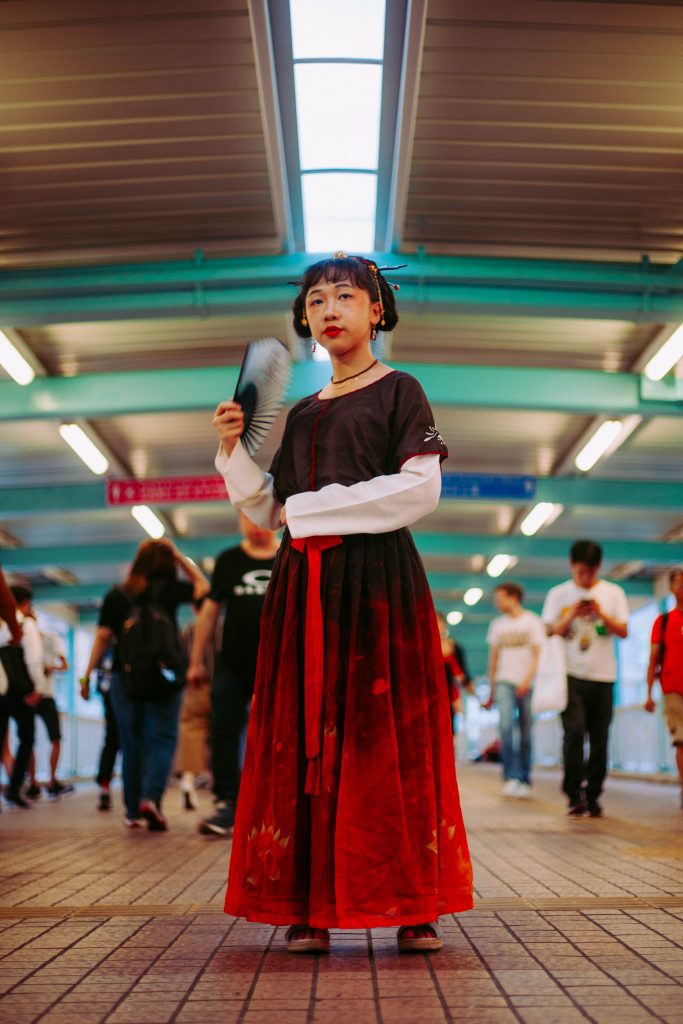
Mandy Chan at Mong Kok station (Camila Gonzalez/RSJ).
Amidst a sticky, humid Hong Kong afternoon, Mandy Chan walks down the stairs at Mong Kok station in a long floral gown. Her hair is tied up in a red, black and gold headpiece that highlights the scoop collar of her dress.
The pedestrian walkway in the Western Kowloon neighbourhood is busy, but a pathway opens up as she walks — passersby stop to stare at the unusual sight. Her vibrant, floor-length Tang Dynasty robe with wide sleeves and colourful accents stands out among the city’s modern flare and neon signs.
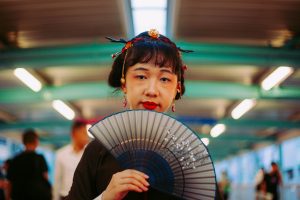
Chan in traditional Hanfu clothing (Camila Gonzalez/RSJ).
Chan has worn traditional Hanfu clothing every day since she was in high school. She learned about the Han people of China during one of her classes and began to wonder why people stopped dressing that way.
“I started to learn more about the culture and the traditional clothing,” Chan said. “I decided it doesn’t have to be history, but it can be alive in the present.”
She crosses the street and enters a McDonald’s to wait for her friend who’s stuck in Mong Kok traffic.
“People need to know you can do anything in Hanfu clothing. You can use an iPhone or eat McDonald’s,” she said. “It’s not a costume, it’s a style.”
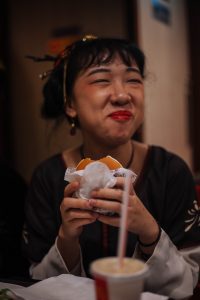
Chan enjoying a meal at McDonald’s (Camila Gonzalez/RSJ).
The 25-year-old grocery store cashier is often in charge of organising meet-ups with others who dress in Hanfu in Hong Kong. The next day, she would be hosting a board game party night at her studio, where she also makes Hanfu clothing.
“There are Hanfu groups all over the world. I know that in England there is a big Hanfu community of people from all backgrounds,” said Chan. “It’s cool if anyone wears it, not just Chinese.”
For her, promoting Hanfu clothing is also about educating people on the history of the outfits and of China.
“It’s the soft power of China. We don’t always need to be known for economic or political power. We can explore our cultural power through fashion,” said Chan. “This is shown when more than just Chinese people wear it.”
Wearing the history of China
Hanfu is a style of clothing that originated over 3000 years ago during a period that was considered the golden age of China. It was made popular during the Han dynasty, which was the second imperial dynasty of China. Today, traditional Chinese clothing is a rare sight in Hong Kong.
Apart from Hanfu clothing, qipao (or cheongsam) is another traditional style of clothing that once ruled the Hong Kong fashion scene. Now, there are fewer than 10 qipao tailors left in the city.
Kan Hong-wing, owner of Mei Wah Fashion, is one of the last tailors in Hong Kong who continues to use the long-established techniques to create the perfect qipao.
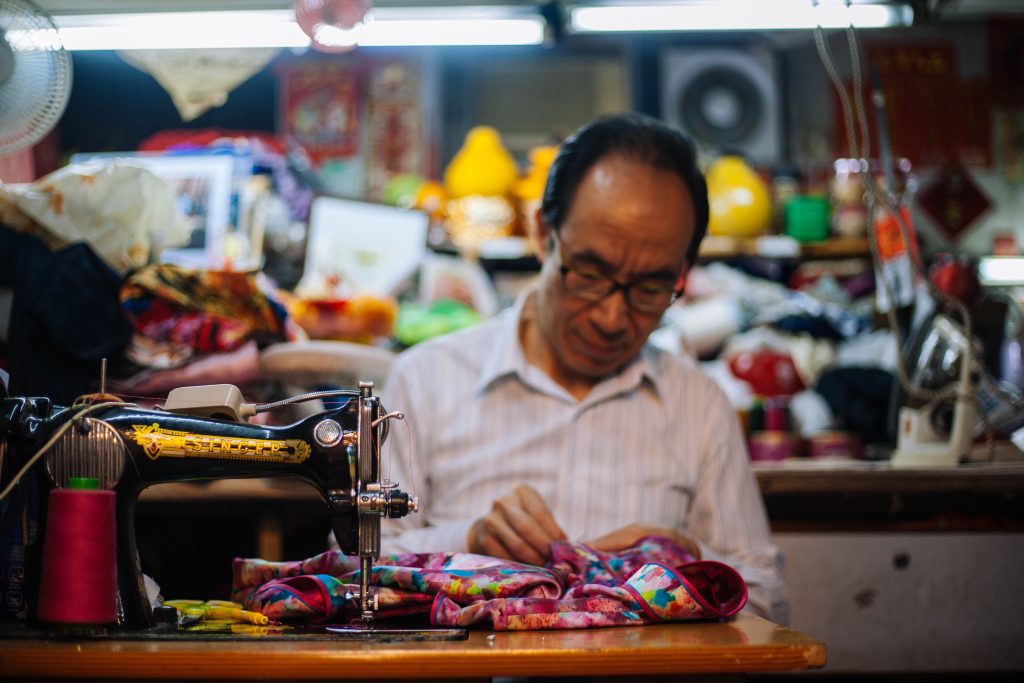
Kan Hong-wing working on a qipao (Camila Gonzalez/RSJ).
The 67-year-old has worked as a tailor for decades. Every seam and stitch he makes is with unapologetic pride. “Working in this industry is a huge responsibility. You need to take it seriously in order to make a meaningful qipao,” said Hong-wing. “You can’t rush things like this. You need to put in your heart and soul.”
His workshop is decorated with rolls of intricate embroidered fabrics covering the walls. It has been in the family for over 80 years and is located in Hong Kong’s Sheung Wan neighbourhood.
His customers come in from all over the world and through all age ranges. “Every girl who wears a qipao is beautiful,” he said.
“It’s all about heart. The person wearing it has to wear it with purpose.” – Kan Hong-wing, owner of Mei Wah Fashion.
Hong-wing attributes the decline in qipao tailors to the difficulty of the skill in comparison to the financial compensation.
“Unfortunately, not a lot of young people want to get into this business because ultimately you put in a lot of effort and don’t earn a lot of money,” he said. “I’ll be doing it until I can’t anymore. When you work in this field for years and you feel so happy, why stop?”
Kan Hong-wing has made thousands of qipaos in his time as a tailor. “It’s impossible to estimate how many I’ve made since I work day through night,” he said. “Years ago, we had around a dozen tailors who worked at my store. Now it’s just me, so the process is a lot longer.”
His orders could take months. The process of making a perfect qipao is slow and precise.
“It takes tens of hours just to finish one, also because it takes a lot of passion and responsibility to make one to suit the customer,” Hong-wing said.
Despite the decrease of demand, he assured that someone in Hong Kong will always want to wear a qipao.
“It’s still a big part of Hong Kong culture, so I’ll be doing it until I can’t anymore. What I do makes people happy. If they like my qipao, I am fulfilled.”
A Cultural Renaissance
Although traditional Chinese clothing seems to be a rarity among Hong Kongers, a local designer is trying to modernise the qipao to make it more functional for today’s society.

Grace in her store (Camila Gonzalez/RSJ).
Grace Lee, a former fashion model turned designer founded Yi-ming in 2011 as an attempt to combine her love for fashion and for her heritage.
Her brand’s name “Yi-ming” is actually derived from her Chinese name in Mandarin pinyin. Her store is located in Sheung Wan, along Tung Street, a bustling neighbourhood consisting of vintage good stores, fashion boutiques and street vendors.
The concept of the store was simple: To attract a younger audience to the beauty of Chinese traditional clothing by creating comfortable, stylish and ready-to-wear qipao inspired dresses.
“We wanted everything to be easier. Traditional qipaos are very tight-fitting tailor-made garments that take a while to complete. Our fashion is comfy, modernised and can be used at a cocktail party or event without looking like a costume.”
Lee said she thinks it’s by modernising the qipao that more people will be introduced to the concept that Chinese clothing can be a daily styling choice. In fact, she said she would like to see more Westerners and non-Chinese people dressing in their clothing.
Earlier this year, an American high school student was heavily criticised on social media for wearing a Chinese qipao to her prom. Lee said she was happy when she saw the news, because it showed Western appreciation for an aspect of Chinese culture.
“I can’t blame her if she doesn’t know the background, the traditions or the history. We don’t know many Western style dress history,” said Lee. “What about the Chinese men who wear suits created by Westerners? Or the women who wear evening gowns. Does that mean we can’t wear that?”
The Future of Hanfu
Mandy’s friend Lexa Lau finally arrives, wearing a draped maroon wide-sleeve blouse with a brown studded belt, a headpiece and a small cross body bag with a wood-carved snake, representing the year she was born in.
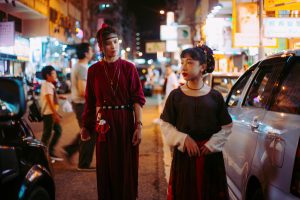
Mandy Chan and Lexa Lau walking in the streets of Hong Kong (Camila Gonzalez/RSJ).
She apologizes for being late. Lexa has opted to wear a different Hanfu style than Mandy. She calls it an exotic mix, that uses styling from mainland Han people and today’s modern clothing.
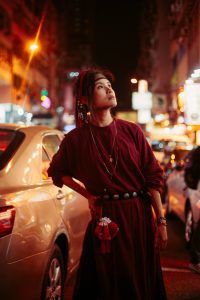
Lexa Lau in traditional Hanfu clothing in the streets of Hong Kong (Camila Gonzalez/RSJ).
“The connection of cultures was common in Tang Dynasty. Different cultures came from other countries to Mainland China through the silk road,” she says, “That is what I am trying to represent today. A connection from the traditional to the new.”
Lexa Lau is a 28-year-old voice actor in Hong Kong, who also wears Hanfu clothing in her everyday life. She realised that Chinese people were forgetting where they came from and wanted to bring back tradition.
“Now I dress not just to look pretty, but to dress myself in our history,” says Lau
Lexa and Mandy know each other through a Hanfu community group that hosts different get togethers and parties throughout the year. It is made up of a large number of Hanfu lovers around Hong Kong, who celebrate and wear Hanfu clothing.
When they walk together along Mong Kok’s busy streets, not a single person walks by without stopping
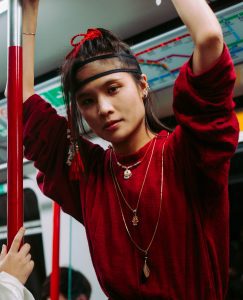
Lau in the Hong Kong subway (Camila Gonzalez/RSJ).
to look at them.
“I don’t feel judged at all. Sometimes if a stranger looks at me weirdly, I just wear my headphones and keep walking,” says Lexa. “Usually people stop me on the street and ask me what I am wearing. Many of them tell me it’s beautiful.”
Mandy’s experience wearing Hanfu has been slightly different. She says she wears Hanfu because it makes her feel beautiful, but her family doesn’t agree.
“My parents and my family know I dress this way, but they don’t like to go out with me when I’m wearing Hanfu. They think it’s too noticeable and striking,” says Mandy. “When I dress Hanfu and I’m alone, they don’t care. But they don’t like going out with me if people are going to look.”
Lexa comforts her friend and adds, “I think Hanfu is loved mainly by young people because we want to remember our culture. Our parents’ and grandparents’ might think it’s beautiful, but they don’t understand it.”
Mandy smiles and says, “I think more people will start wearing Hanfu, especially in mainland. The government in China wants to connect people back with their culture and revive Hanfu. It will be very normal, not just historical.”
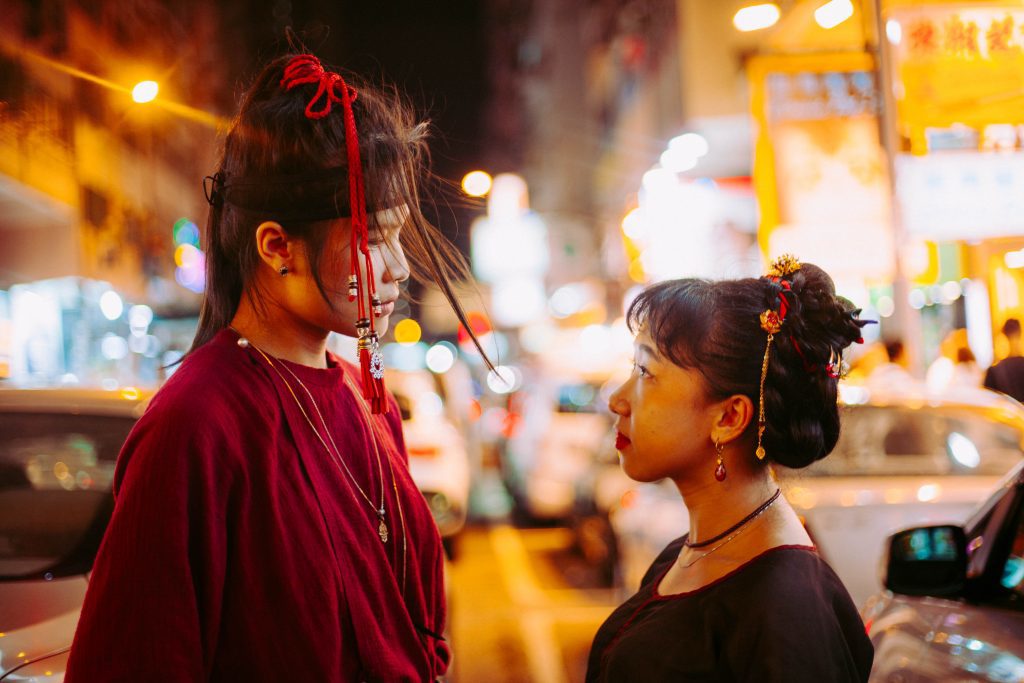
Mandy Chan and Lexa Lau in the streets of Hong Kong (Camila Gonzalez/RSJ).
The future of traditional fashion in Hong Kong is uncertain, but there is a growing amount of local and international designers who are incorporating historical aspects of Chinese design into their collections.