
To view this 360 video in mobile and/or with a headset, click right here.
Hong Kong’s pro-democracy front splinters from the emerging generation of activists.
BY TIFFANY LAM
Hong Kong’s Causeway Bay subway station is typically a bustling downtown stop where riders emerge shoulder-to-shoulder already. But every year on June 4th, extra metal fences are installed to shepherd added human traffic from the escalators leading up from the subway platform. Traffic cops bark instructions to move towards your exit. Most people seem to be going towards Exit E – Victoria Park.
Victoria Park hosts a vigil every year on June 4th to commemorate Beijing’s crackdown on protests at Tiananmen Square nearly three decades ago. The event is held by an organization called the Hong Kong Alliance in Support of Patriotic Democratic Movements in China; the Alliance, for short. According to the Alliance’s website, they are the “child of the ‘89 pro-democracy movement,” born out of the moment when China’s then-Premier Li Peng declared martial law in Beijing on May 20th, 1989; protests had persisted since April 15th. When protestors refused to leave Tiananmen Square by June 4th, the city fell silent under military force.
At the event’s peak during the 20th anniversary of the crackdown, 200,000 people attended the candlelight vigil to memorialize those whose lives were forever changed by their government. At this year’s 29th anniversary, organizers counted over 150,000 people at Victoria Park.
One attendee of the vigil recalls what she saw on cable news in 1989 but will not give me her first name or have her picture taken. “I saw tanks hit people, I saw fire, and a whole night of loud noises that sounded like explosions,” Yeung, 60, said.
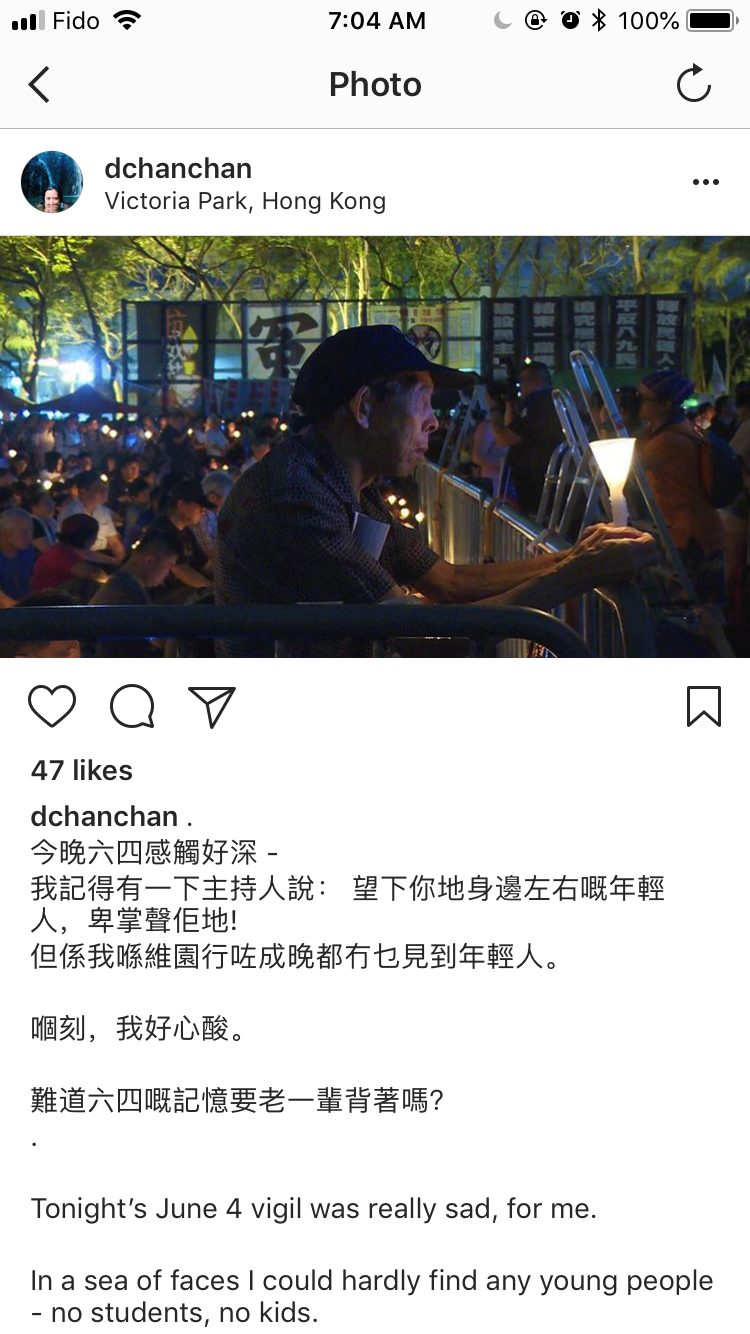
An old man is right up at the front against the media pit two hours before the event starts. He says he always comes early to get a good view. His accent speaking Cantonese suggests he is likely a transplant from the mainland. He is 89-years-old this year. He has gone to every vigil since 1990 when the Alliance first started holding them. He doesn’t want his photo taken nor does he want to be identified. When asked why, he laughs earnestly and says, “The government feeds me!”
The people around him stake out territory for their fold-out stools. It’s raining intermittently. Some people lay out plastic tarps and grocery bags to sit somewhere dry. Organizers punctuate the crowd, handing out candles to attendees. Media is setting up at the pit; veteran cameramen have personal ladders for better vantage points. The park’s flood lights go off and a slideshow begins behind the massive stage.
Silhouettes chant, “Rehabilitate June 4th’s Movement!”
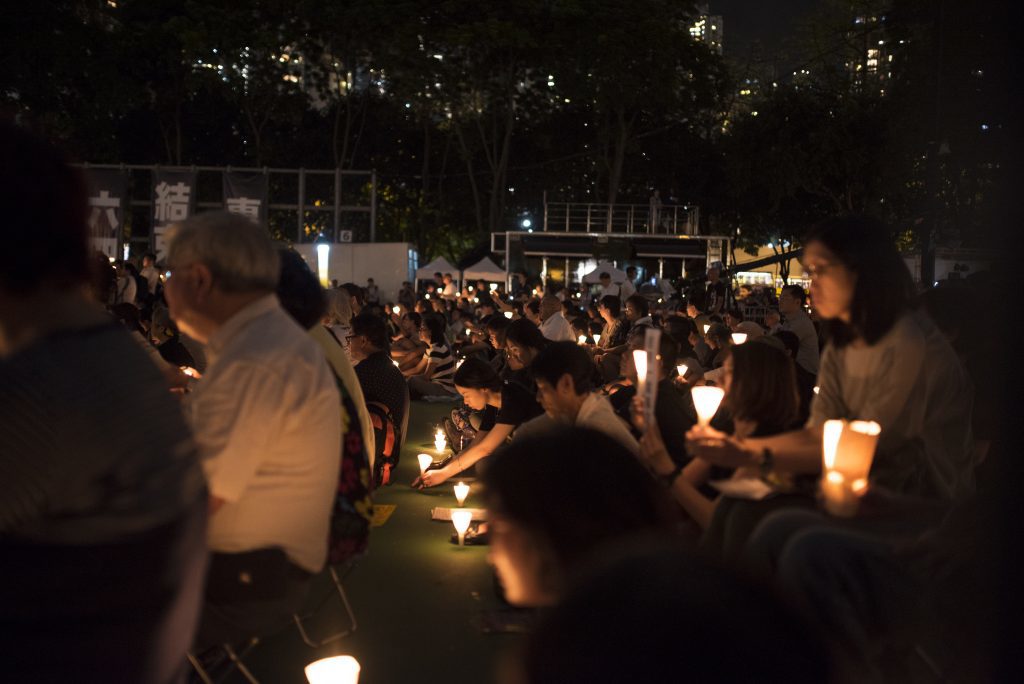
Crowd falls silent as flood lights go off (Photo: Declan Keogh)
~~~
On the other side of the Hong Kong harbour is a smaller vigil that began assembling in 2012.
Unlike the one at Hong Kong Island’s Victoria Park, this vigil does not have permission to assemble. There seems to be more media and police personnel than there are attendees. Nevertheless, this vigil feels more intimate. There is no giant stage set up, elaborate banners, or 18-point programs.
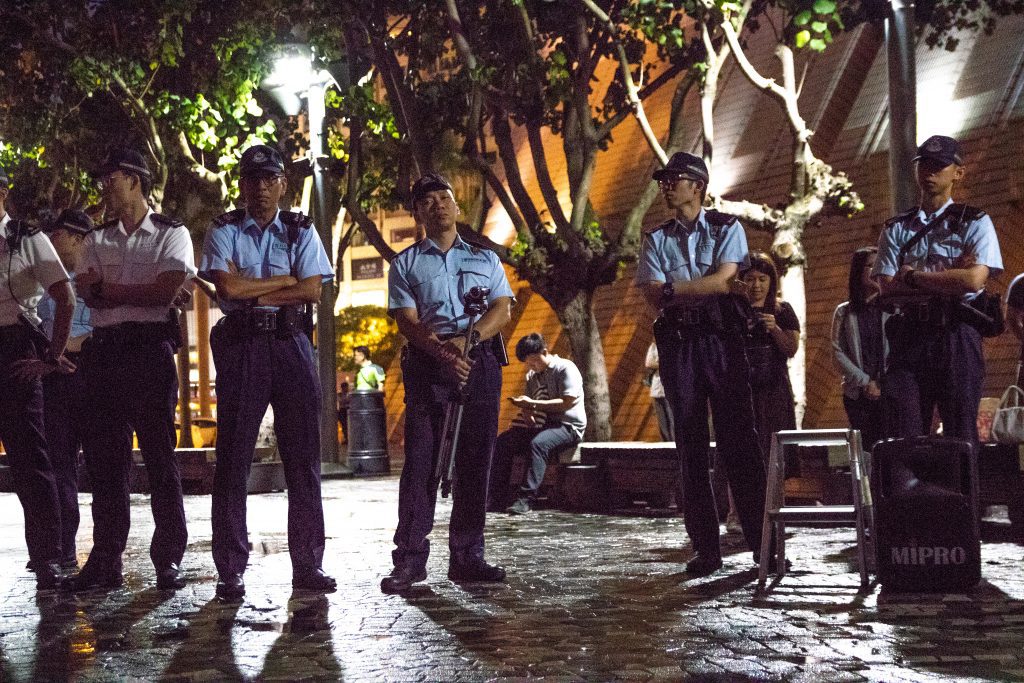
Police stand by at the alternative vigil at Tsim Sha Tsui (Photo: Celina Gallardo)
“The difference between our vigil and theirs is we don’t necessarily agree on the founding principles of the Alliance. In particular, to ‘rehabilitate’ the democratic movement and to build a democratic China,” says the alternative vigil’s organizer, Michael Mo.
Mo, 32, is the lead organizer of this alternative vigil and a recent graduate of Hong Kong University’s Master of Human Rights Law program. Mo hopes to spread international attention to the Tiananmen crackdown by having an English language vigil. He also wants to stress the demands of the Victoria Park vigil do not resonate with him or his peers.
Mo is among the contingent of younger Hong Kongers who no longer wish to continue the tradition from April 1989, when the first Chinese students protested for democracy by calling for the end to political corruption, inflation, and subsequent material dispossession. Mo says this distancing is due to the tension between mainlanders and Hong Kongers in their day-to-day lives.
“You’re actually ruled by different people who claim superiority, and that’s in no way good… They come to Hong Kong and say, ‘It’s part of China, we don’t have to speak in Cantonese or to learn traditional characters. You have to accept us,’” Mo said. “The real Hong Kongers face challenges like that every day. Building a democratic China will not benefit their livelihood or their future… They don’t believe a democratic China will make Hong Kong a freer city anyway.”
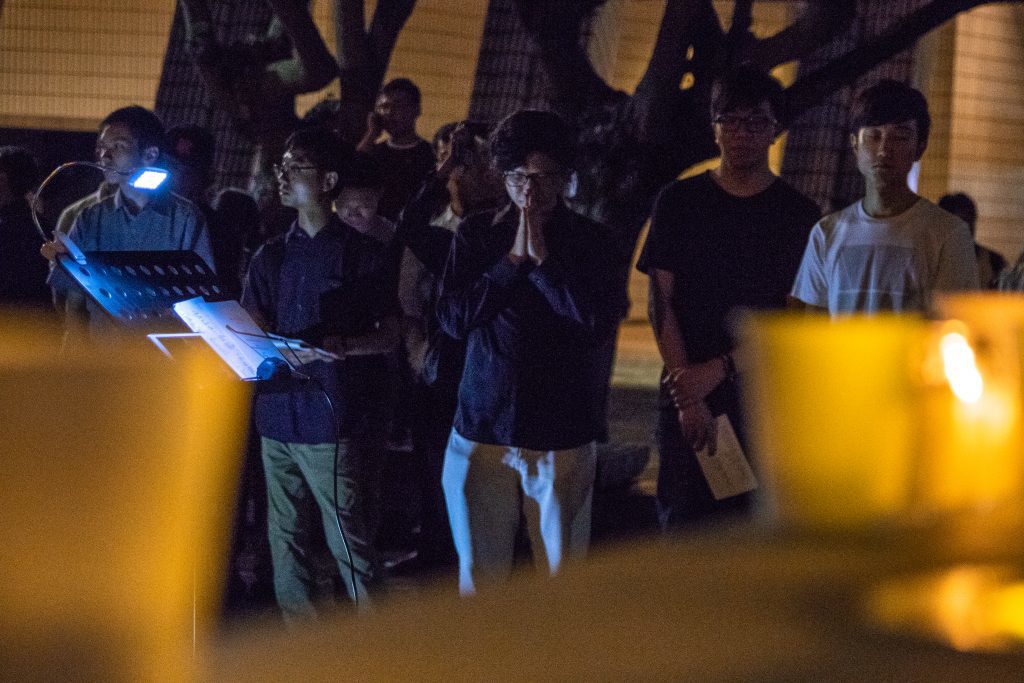
Michael Mo closes his eyes in silence at the alternative vigil at Tsim Sha Tsui (Photo: Celina Gallardo)
Chan Kakui, 19, a leader of the Students Independence Union, agrees. As the organization’s name suggests, Chan’s organization seeks independence from the mainland. Chan says he does not go to the Victoria Park vigil because it is too focused on democratizing China. “We want to find differences between Chinese and Hong Kongers. This way, we can do more for ourselves to fight.”
Approximately 150 people, including about 50 members of the media, gather at the deck outside the Cultural Centre at Tsim Sha Tsui. They congregate near a statue officially called The Flying Frenchman. The original name of the statue, Freedom Fighter, was rejected by Hong Kong’s government. Mo nevertheless uses the latter name for this vigil’s Facebook event.
Carmen Lo, a resident of Hong Kong, decided to come to Tsim Sha Tsui this year for a change of scenery. “You cannot compare to the Hong Kong side vigil. On the Hong Kong Island, it runs for many years with the same style. But here, it’s a memorial. An event to take photo and observe silence to remember the past history.”
This year, eight university student unions boycotted the main vigil on the Island, highlighting a rift between how Hong Kongers care to memorialize the event. Mo publicized his alternative English language vigil on his public figure page on Facebook, emphasizing their vigil was to “call for truth and justice at national, regional and international levels.”
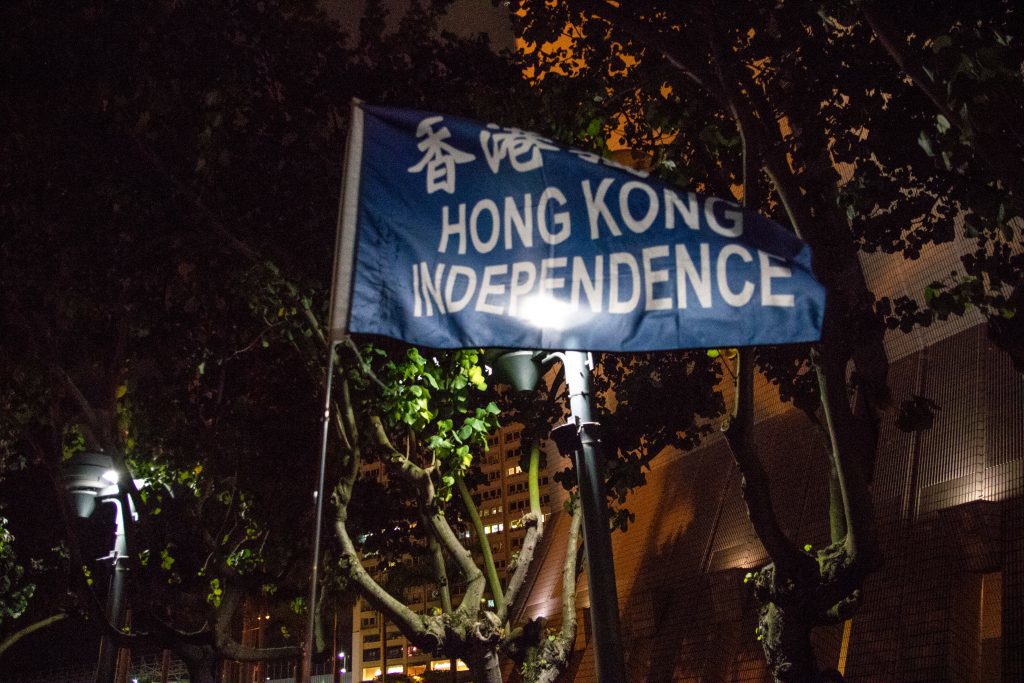
A flag for Hong Kong Independence (Photo: Celina Gallardo)
~~~
Despite the divide over what justice for June 4th looks like, the vice-chairman of the Alliance is adamant that fighting for a democratic China does concern Hong Kong.
Richard Tsoi, 50, says there is no escaping the political reality that Hong Kong has been a part of China under the “one country, two systems” constitutional principle since the 1997 Handover from British colonial rule. Under this system, Hong Kong will have to relinquish their separate constitution – the Basic Law – in 2047.
“If you want Hong Kong to move to a good direction, you can’t ignore China,” Tsoi says. “We are now, constitutionally speaking, a part of China,” Tsoi said.
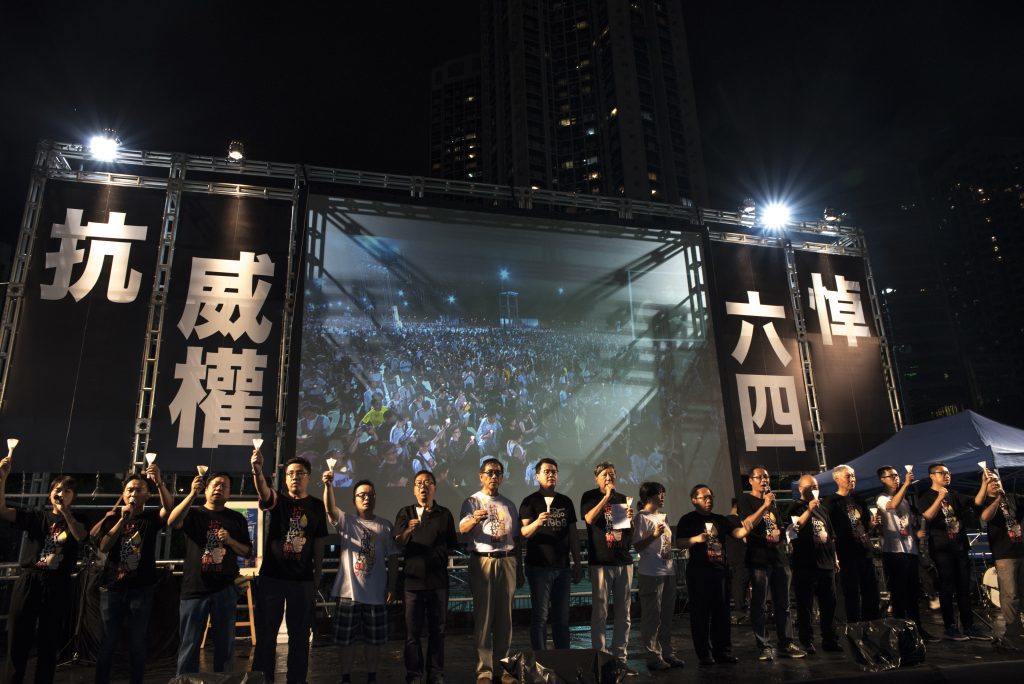
Richard Tsoi addresses the crowd on the microphone at the Victoria Park vigil (Photo: Declan Keogh)
In contrast to Mo, Tsoi is convinced that commemorating June 4th is deeply entrenched in Hong Kong’s heritage. For him, the ability to protest injustice is central to what sets Hong Kong apart; it is one of the three places on Chinese soil where peaceful assembly is still tolerated. “I consider June 4th the most important social movement in Hong Kong. Even nearly 30 years on, tens of thousands of people, hundreds of thousands of people come out to participate,” Tsoi says.
Tsoi emphasizes this vigil is a major strategy in enlarging civil society and political participation. “It’s important to enlarge [this space]. It’s good not just for Hong Kong, but also the greater China,” he says.
Klavier Wong, a researcher of emerging Hong Kong’s social movements from Hong Kong Baptist University, says the “alternative vigil” is symptomatic of a structural change. “For me, it’s not right or wrong,” Wong says. “This is a change of relations between Hong Kong and China, and a change of perception about China.”
Wong says the structural shift may stem from the different generations having less family and other affiliations with the mainland. Hong Kong’s colonial status under British rule made it a popular destination for mainlanders seeking to leave poor conditions in their hometowns. She also thinks the costly rise of China in the global economy also influences Hong Kongers’ relationship with the mainland.
“I think different generations see a different China,” Wong said. “The young generation has grown up and seen a not so good China. The economy is rising, yes, but there’s poisoned food, corrupted government… Compared to the previous generation, who saw a poor China, a China that needed help, a China struggling for socialism. Something like that.”
Indeed, the memory of 1989’s events are far more immediate for Tsoi. In 1989, Tsoi was a student at the Chinese University of Hong Kong. His student union had sent a delegation to Beijing when protests began. “We also organized our own demonstration in Hong Kong,” Tsoi said. “More than one million Hong Kong people participated in 1989, supporting the student movement in Beijing.”
Tsoi has peers in the Hong Kong pro-democracy contingent at the Square, who were led to safety by mainland Chinese students.
He tears up as he remembers his peers telling him about how students from the mainland got his friends back to safety: “‘Make sure the world knows the truth,’ they said.”
~~~
When the Victoria Park vigil finishes, workers expertly pack it up. On the way back to Victoria Park station, the most committed activists still line the streets. People are selling “Remember June 4th” merchandise. The Hong Kong Federation of Trade Unions and several Hong Kong political parties are still there. Joshua Wong, 21, the man internationally known for his role in the Umbrella Movement’s demand for freer elections, is shouting on a megaphone to support his party. The biggest denomination in donation boxes is a golden-brown bill – 500 Hong Kong dollars, which is about $83 CAD at the time.
To this day, no official figures exist about the damage caused: no reports on injuries, no death toll, no one held responsible.
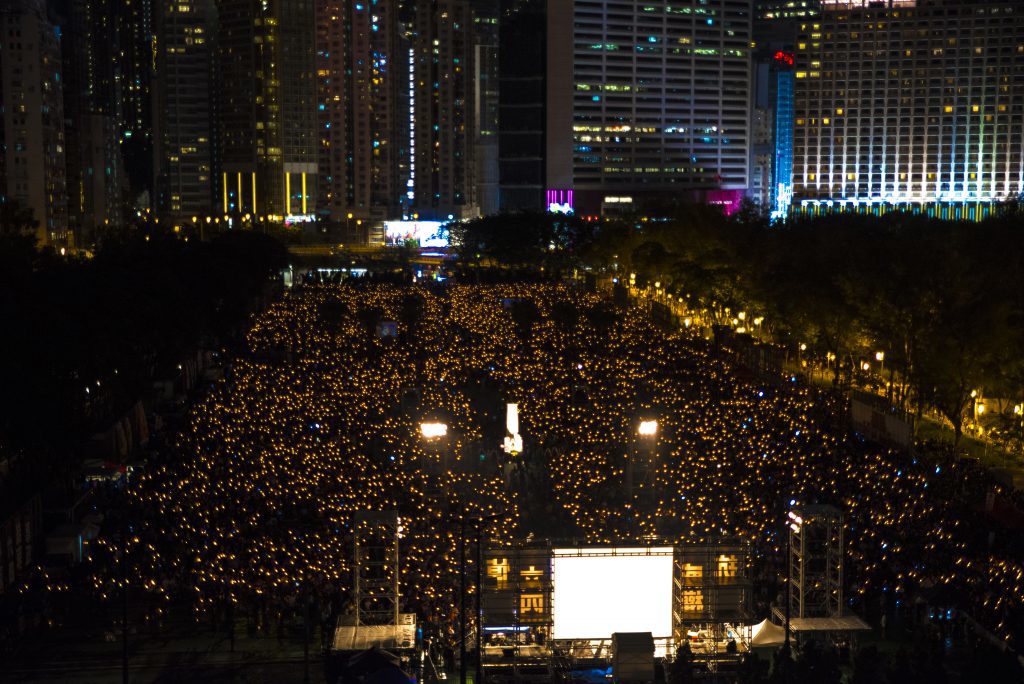
150,000 people attended Victoria Park’s candlelight vigil for its 29th anniversary (Photo: Declan Keogh)
“I would say if China wants to stand itself as a strong, respectable power, they should submit themselves to International Criminal Court. Let the Court decide who should pay for the price,” Mo said.
A photo of the old man who did not want to be identified is published on a journalist’s Instagram later, still unnamed but a symbol of persistent protest.
Special thanks to: Zoe Law, Declan Keogh, Adam Chen, Marissa Frosst, Celina Gallardo