
The story of Ma Wan, a 250-year-old abandoned village and what it means for Hong Kong
BY DECLAN KEOGH
In one building, a hand-drawn picture, made with a black marker and coloured with crayon, is still taped to a wall. It shows two smiling girls beside a large pink heart and reads, “Mum, I ♥ U.” The small, glittered hearts that surround them are now faded, the years of dust have settled into their colourful glue.
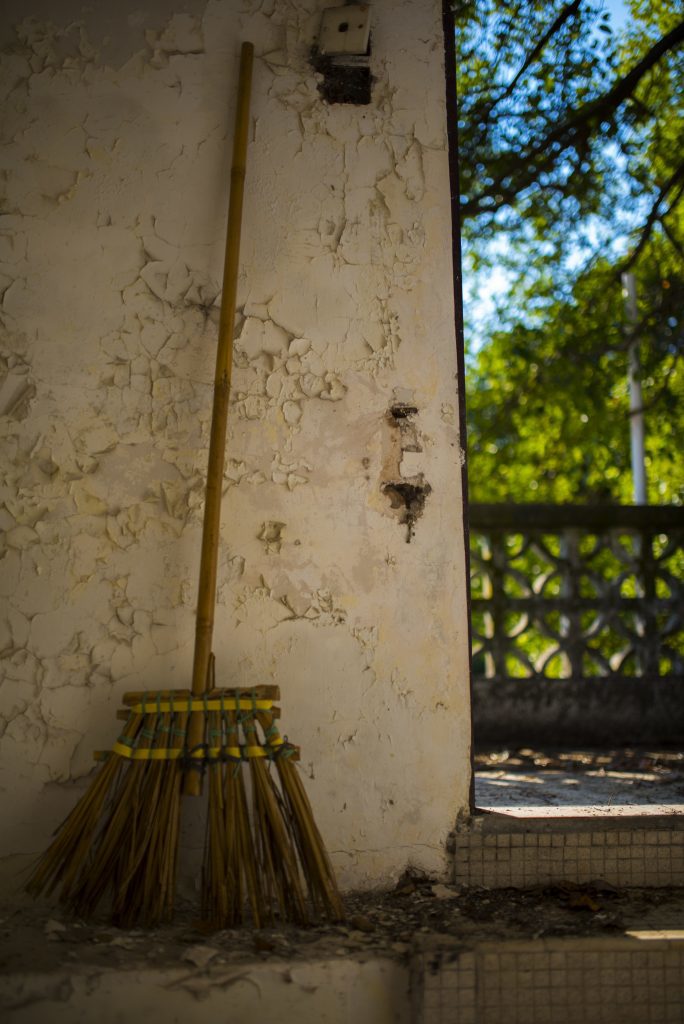
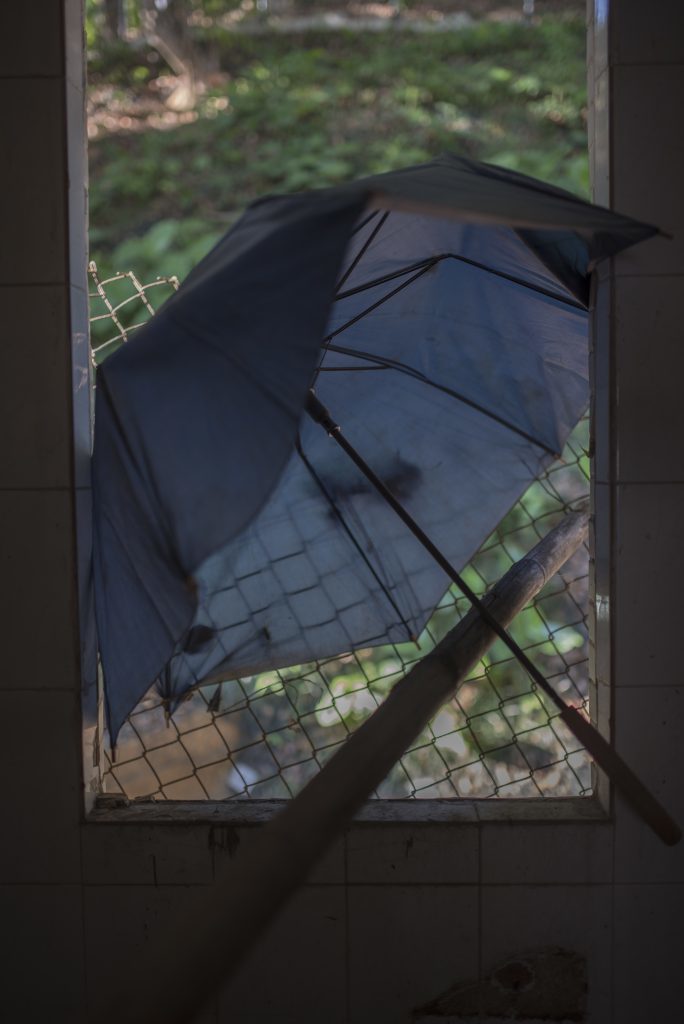
In another, washed out posters dot the walls. The pop stars are barely recognizable and mostly forgotten. Mouldered newspapers litter the buildings, reporting on the happenings of years before: elections, protests, China, rental prices and wages.
Here, on the east side of Ma Wan Island, roughly 21 kilometres by land from the bustling Central Pier on Hong Kong Island, and nestled between the larger and more developed islands of Lantau and Tsing Yi, lies the abandoned village of Ma Wan. Once home to over 2,000 Indigenous villagers, it is now a crumbling hamlet of mould, graffiti and broken windows. History echoes throughout the overgrown foliage and unmaintained structures.
“It’s good to talk about old memories,” Sung Luk Chan says. He is one of a handful of relocated villagers that frequent the ruins of their past lives. Chan, 65 and retired, worked in construction. Although his hands are rough and calloused, the smooth, tight skin on his face betrays his age. He often comes back to the village to watch the ships pass and talk with his lifelong friends.
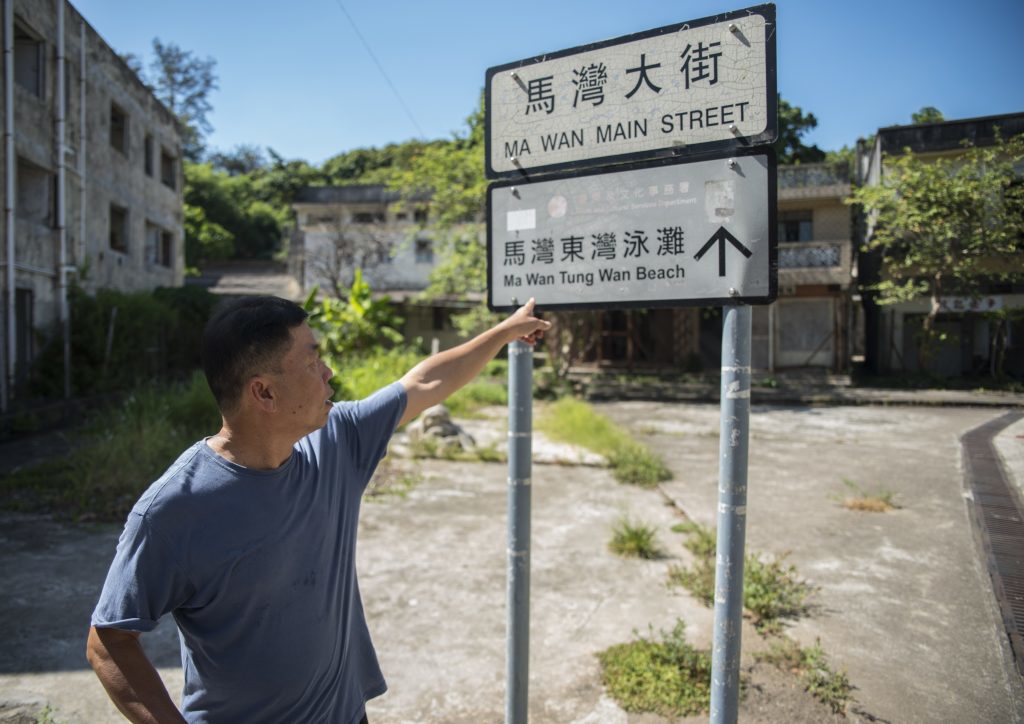
Sung Luk Chan, 65, wants to see his ancestral village restored or demolished – anything but left to rot, May 30, 2018.
Chan’s family lived in the village for generations in a large, three-story building that looks like it could be an apartment. Its exterior yellow ceramic tiles are faded, bleached from decades under the sun.
He remembers it being inconvenient to live in Ma Wan, due to a lack of transportation, amenities, and economic opportunities. The power company China Light and Power (CLP) Group never set up proper lines into the village, so they had to use a generator for power. In the heat of the summer, they were often told not to use their air conditioners, to avoid overloading the grid. At one point, they tried to set up lines through the water from Kowloon, but fishing boats kept hitting them. It would get so hot that Chan would burn his shoeless feet on the pavement under the 30-degree sun.
Despite the difficulties, Chan speaks of his childhood fondly. As kids, they managed to live a typically rural existence just kilometres from one of the world’s busiest cities, spending their time fishing, swimming or bickering with each other. But now, amongst the decaying remnants of that past life, he sees how things in Hong Kong have changed.
In a so-called global city like Hong Kong, one can often get lost in the dazzling skyscrapers, numerous cultures and industry. There’s a romance associated with the narrow streets that crisscross the mountainous terrain at impossible inclines. The backbone of the city: its transit. Below the streets, the prized Mass Transit Railway (MTR) serves thousands of people every hour; and above, hundreds of small, red taxis race through the streets as the cumbersome, yet iconic, trams lazily shuttle tourists and residents alike.
Hong Kong has stood as a cultural breakwater in the South China Sea: colonial European customs and traditions wash over and mix with Chinese conventions, creating the unique behemoth it has become. The city’s dramatic rise as an international hub and economic powerhouse has created a dichotomy between the past and the future, pitting cultures and traditions against each other in our ever-changing world. The push towards new horizons has left parts of the city forgotten – cast aside and left to stand alone through decades of development and change.
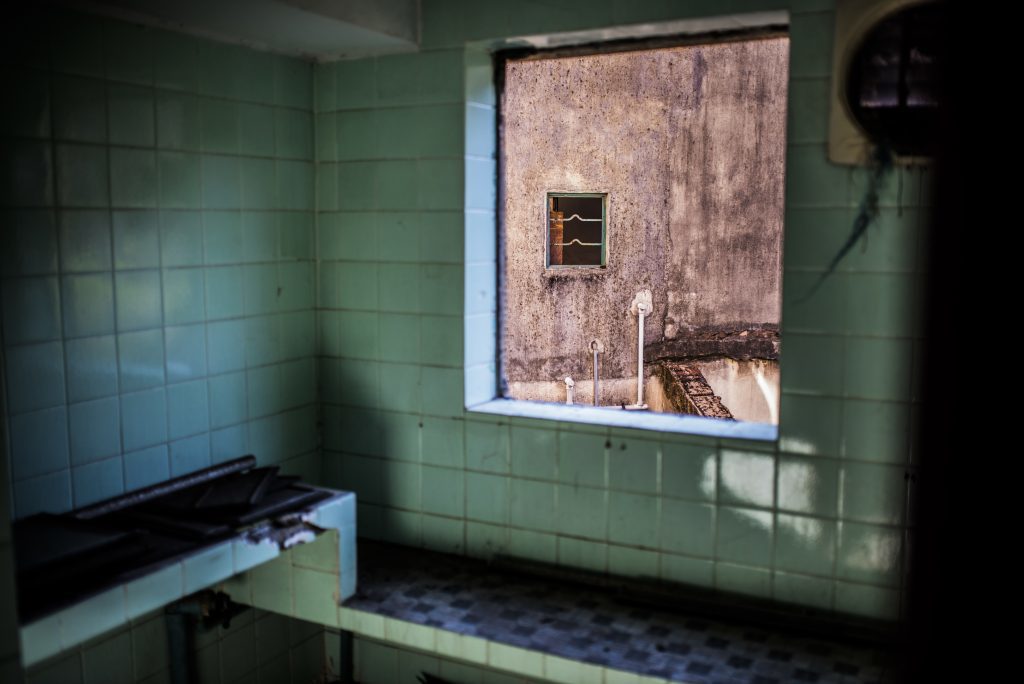
A view from inside one of Ma Wan Village’s abandoned homes.
Dotted throughout the city’s expanse are abandoned sites, like Ma Wan Village, known as brownfields. While there are no precise figures on how much land these sites occupy, government estimates place them between 13 to 37 kilometres. A comprehensive study is due by the end of 2018.
While some brownfields have been converted into storage for shipping containers or other industrial uses, many are left derelict. Often, the land is privately owned, which can make government intervention and development a slow and clumsy process. Speculators, including Chan, think it comes down to people sitting on their land in the hopes of turning a larger profit further down the road.
“You can’t see the future, not like when I was young,” Chan says. “I was optimistic about Hong Kong’s future, but now there are a lot of changes after the Handover to China.”
“There is a tendency for people to grasp onto something – to preserve.”
Ma Wan traces its roots back over 250 years.
Throughout most of its history, it was a quiet fishing village far from the bustle normally identified with Hong Kong. It’s most known commodity was shrimp paste, once said to have been the first thing one would smell when stepping off the ferry onto the island.
It’s boarded windows and spray-painted walls lie in stark contrast to the rest of the city, which has one of the densest and most expensive housing markets in the world. A 2017 British Broadcasting Corporation documentary, World’s Busiest Cities, had Hong Kong as the sixth most densely populated area. In 2014, the land population was 6,690 persons per square kilometre, according to government statistics. Kwun Tong in Eastern Kowloon is the densest district at 57,250 persons per square kilometre.
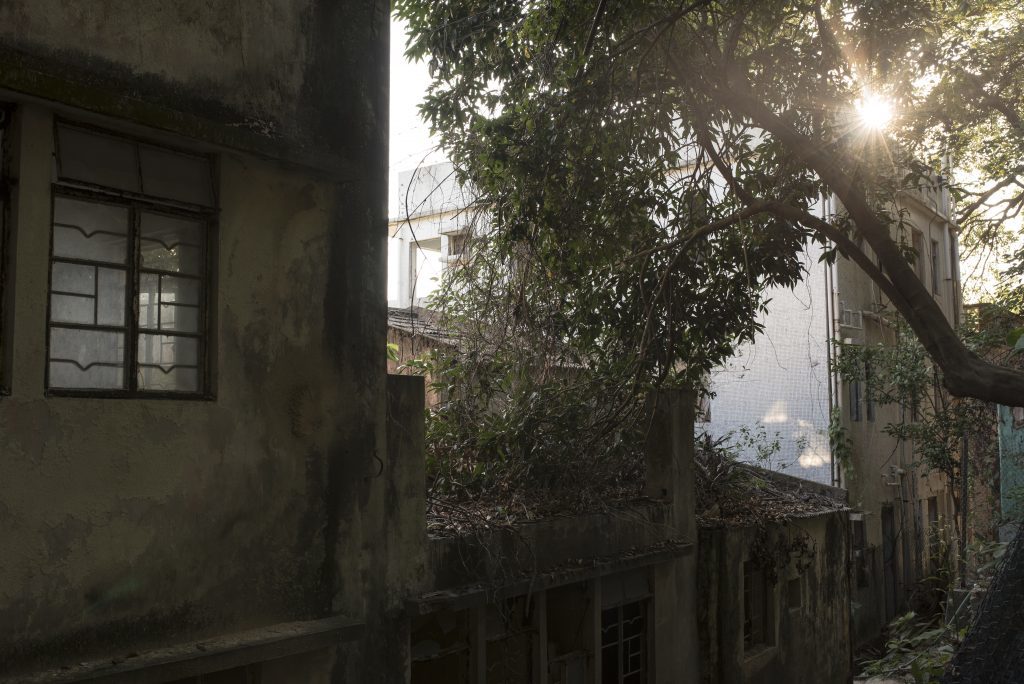
In the midst of declining development and a land crisis, Ma Wan stands as a historical dam.
Perhaps, it is this density – and all the accompanying development, that keeps bringing villagers like Chan back to their ancestral lands, long after they’ve been abandoned. Thirty years ago, Ma Wan Village was home to roughly 2,000 people. Over the decades, its population shrunk: about 800 in 2000, down to a handful of squatters left today.
“I like living in rural areas. You tell me to live in the city and I wouldn’t. I’m used to it, you can walk everywhere,” Chan says. When he visits the neighbouring island of Tsuen Wan he doesn’t stay long, not liking the crowds, traffic or heat. “They live in cities and have no choice.”
 In the decades since the handover, there’s been a political and cultural shift in Hong Kong, says Cecilia Chu, an architecture professor at Hong Kong University. Chu has written extensively on urban planning, and how culture and history intersect with development. She says there is a general pessimism about economic development and Hong Kong’s role going forward. “There is a tendency for people to grasp onto something – to preserve.”
The overall density and that of Hong Kong’s neighbourhoods vary greatly. This is because roughly three-quarters of the lands are undeveloped, with only seven per cent of land going to residential space, leaving residents with some of the smallest living spaces in the world –averaging 161 sq. ft. per person, according to government statistics. On top of this, abandoned villages like Ma Wan dot the land, especially in the more rural areas of the New Territories.
Poorer people have even less space. Those who live in partitioned cubicle-style apartments in Kwai Chung in the New Territories have 50 sq. ft., according to a 2017 study. For context, prisoners in shared dormitories have 49.5 sq. ft. and those in maximum-security facilities are required to have 75 sq. ft.
Hong Kong’s population explosion, more than tripling since 1950, coupled with large swathes of undeveloped land, has led to a housing crisis. Average rental fees per sq. metre in the first quarter of 2018 range from the equivalent of C$300 month on Hong Kong Island to $241 in the New Territories, according to statistics retrieved from the Rating and Valuation Department. Buying property is also expensive: $60,000 per sq. metre in Hong Kong to roughly $80,000 in the New Territories. The Median monthly wage across all industries in 2017 was around $2,750 per month.
These intricacies of Hong Kong life seem like a distant afterthought in Ma Wan, where one can stroll throughout the relics of bygone eras and see no one but an enterprising photographer or a hobby fisher.
The city’s problems seem to be compounding towards a climax with the end of the 50-year “One country, two systems” experiment in 2047, which was instituted after the 1997 Handover. Ma Wan’s issues, which on the surface seem much smaller, speak to a growing uncertainty of what lies ahead for Hong Kong. In this sense, the quiet and lonely village may just be a barometer which one might use to assess lingering questions.
Chan makes his way through his old village he points out the fenced off and gutted buildings – describing what they used to be.
A former general store, its pantries have long since emptied. He remembers the package noodles, vegetables and snacks that used to line the walls. Chan takes a left down the main street, intent on finding the factory he used to work at. An empty, jungle-like lot overgrown with vegetation is there to greet him. He slowly makes his way to the fence, putting his fingers through the rusted links. He shifts his weight so that he’s leaning forward into the fence, like a kid watching his friends play a baseball game.
“Tearing down the buildings to build flats before everything is finished is not ideal,” Chan says.
How Ma Wan got to be this way, is a decades’ long story. It involves government mismanagement, greed, protests and bureaucratic foibles. Arrangements for the island’s purchase by Sun Hung Kai Properties (SHKP) were underway in the early 1990s. By 1997, SHKP had purchased the northeast side of the island for $3.712 billion.
Now a glitzy upper-class neighbourhood, completed in 2002, Park Island is a desirable area for Hong Kong residents looking to get away from the density of other parts of the city. There are roughly 15,000 people living on the island, with a majority of them in the Park Island development. Over 50 per cent of those on the island bring in over HK$30,000 a month, with 35 per cent bringing in over HK$40,000, according to the 2016 census.
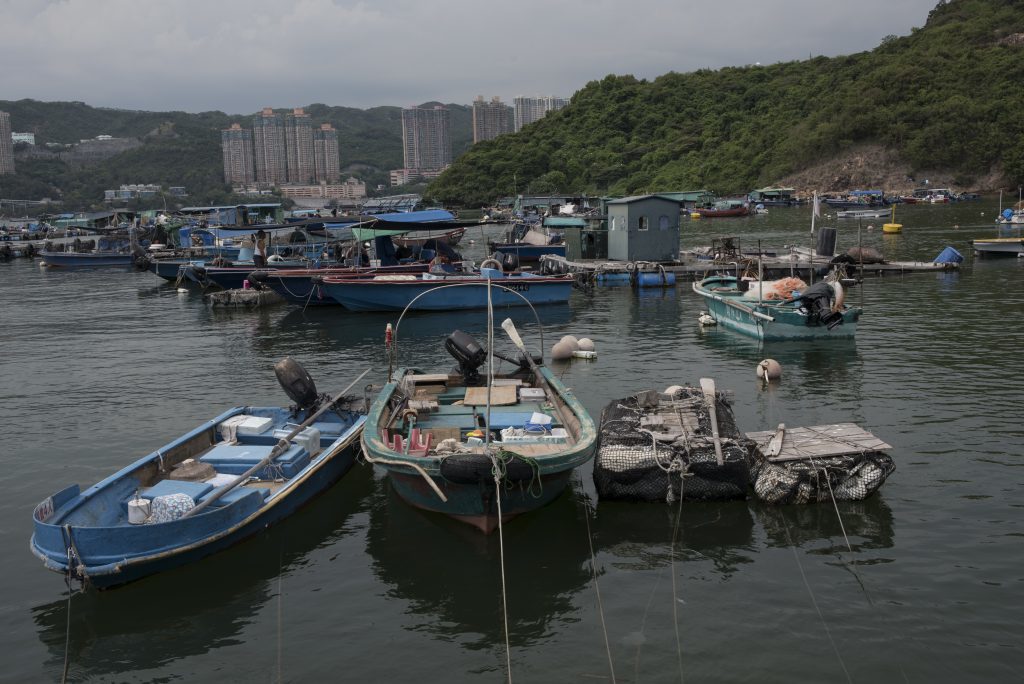
Local’s from the neighbouring fishing village still venture out to catch small fish and shrimp.
SHKP also built the Noah’s Ark resort and hotel, which opened in 2009. The evangelical Christian-themed resort reflects billionaire former co-chairman Thomas Kwok Ping-Kwong’s religious beliefs.
In 2014, Kwok was convicted of corruption and given a five-year sentence. He was found guilty of bribing Rafael Hui Si-yan, a former top Hong Kong official, of HK$8.5 million. Hui was directly in charge of Ma Wan, as well as other surrounding areas. During the trial, a 1995 memo from Kwok was read that stated the Ma Wan Park project was “only an excuse” to evict the indigenous villagers in the area. His lawyer disputed this charge, saying he became deeply attached to the projects.
At the time of writing, SHKP has not responded to multiple requests for an interview.
Although the legal problems of SHKP’s top executives may have played a role in Ma Wan Village’s stagnation, many had already left the village. As part of the relocation plan, some residents were offered space in new three-story flats in what is now known as New Ma Wan Village.
Not everyone was offered this compensation, as not everyone who lived in the village was considered indigenous. An indigenous villager in Hong Kong is someone whose family was established before the British took over in 1898.
This resulted in protests decrying the system used to evict the residents. Many of the signs that were hung by those in opposition are still there. The messages say that 28 families were left without a relocation package or plan, despite what SHKP had originally promised.
It remains unclear why nothing has been done with the old village. It has a picturesque view of the ocean and Lantau Island; it faces westward and every evening is met with the neon sherbet Hong Kong sunset. Chan thinks it’ll end up looking like the other shore of Tsuen Wan: a conglomeration of high-rise residential units that were also built by SHKP.
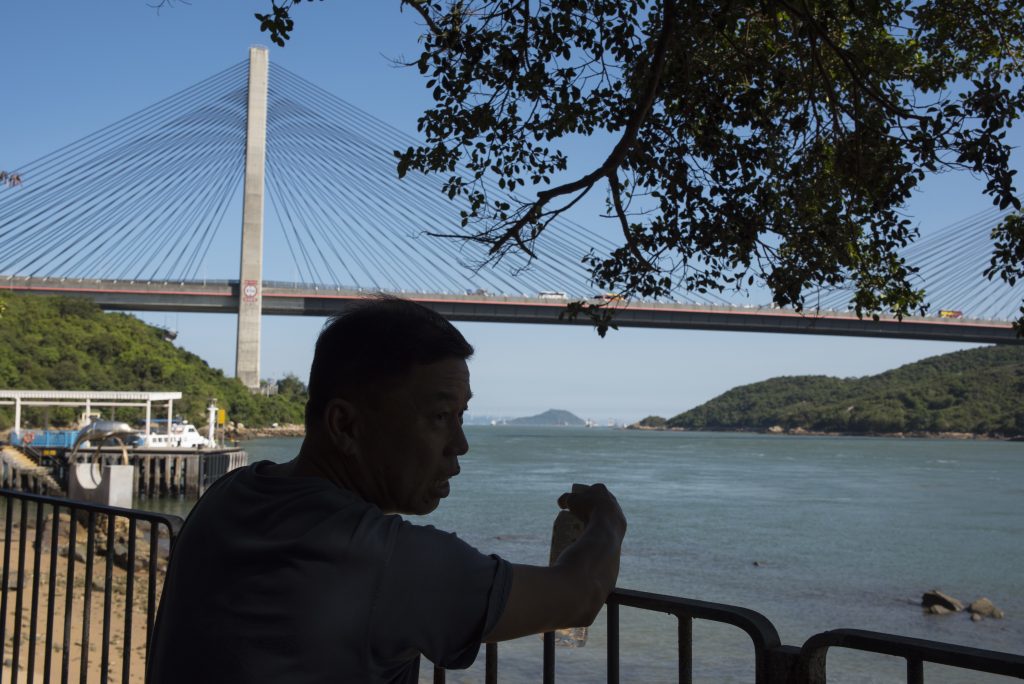
Sung Luk Chan looks out over Ma Wan Channel and the Kap Shui Mun Bridge, May 30, 2018.
Ma Wan Channel and Kap Shui Mun, which surround the village, are some of the deepest waters with the strongest currents in the harbour. As a result, most of the ships that pass through it carry hazardous material and dangerous materials. New developments must not interfere with the shipping channels, according to a 2009 government document obtained by Ryerson journalism students. The zoning plan also outlines that any existing buildings with historical significance “should be preserved as far as possible.”
Chu says there are a lot of young people in Hong Kong who are unhappy with Beijing and the way things are going. But she believes focusing on abstract ideas like universal suffrage make change hard to achieve because Hong Kong is at a disadvantage.
Instead, Chu says that by looking at concrete issues, such as Ma Wan, it makes it easier and more tangible for people to grasp.
By talking about issues like housing, a lack of public space and high land-price values, Chu says people can pressure the government by “using those subjects to expose the lack of transparency and lack of democracy.”
Man Fat Wu, 63, is one of the villagers who was relocated to the newer community in 2012. He lives at the edge of the newer settlement, on the ground floor of the dijon-coloured three-story building. His father didn’t believe in the plan, not trusting SHKP, so they never signed any contracts. However, the government gave them money to move, Wu says.
He enjoyed living in the village, he found more peace away from the busier side of the island. Now he lives beside the main road and the loud buses bother him. Every day, he goes back to the old village to walk in the tranquility that the neglected buildings offer.
“Sometimes, when I walk down there, I’m reminded of what a shame it was that we had to move up here.”
Man Fat Wu, 63, says the Umbrella Movement helped create a fracture between generations in the city.
Wu doesn’t like to leave the island, he says he doesn’t see the point in wondering Hong Kong’s sprawling shopping malls.
The goal for those that were resettled from the old village to the new was to have them living beside their old neighbours, Wu says, but that it also depended on the size of the original property. Other villagers ended up purchasing the land that they were resettled on from the government and now they rent out the units to tenants.
“The village used to be a place where everyone had their doors open,” Wu says. “But now everything’s been moved apart.”
It’s harder for the next generations, Wu says, because they don’t have the same connection to their community that he did. He sees a rift in Hong Kong’s youth – they don’t like China’s overbearing presence and they don’t like the Legislative Council’s notorious bureaucracy.
For Wu, things were better when Hong Kong was still a colony. There was more order, more organization and a respect for the rule of law, he says.
“These days, the Legislative Council can do whatever they want – unlike what it was during British rule.”
For both Wu and Chan, it’s as though their identity, and that of Hong Kong’s, is tied to their village. They don’t want to see it waste away in front of them, but they want more than just another hulking concrete-and-steel complex. Chan is resigned to spending his time amongst the living memories in the village. He’d like to see it restored into some kind of historical park, where residents and tourists can experience what he did as a child.
“I want it to develop. The government officials wait around and if you don’t tell them to do it they won’t,” he says. “That’s why the place is so broken.”
Hong Kong’s identity is being threatened by ongoing development and the integration with China, Chu says. “It’s almost like two forces: on the one hand, you’re getting this super continuous ongoing development; and on the other hand, people are becoming more aware of the history and the culture.”
But, Chu also recognizes that without China, that identity would be totally different. The looming dominance of Beijing, in a sense, created the Hong Kong we now know. “You grow up in a town and without external threats, without any dynamics that threaten it, or shake it up, you won’t even know or be aware.”
Behind the byline
This story was originally pitched as a profile on the group HK URBEX. However, after going to Ma Wan alone, the day after I landed in Hong Kong, I felt that the best story would be to find people who grew up in these places.
Although they didn’t make the cut, we went to a number of different abandoned villages and sites around Hong Kong, meeting a number of people along the way. What struck me was this intangible hold that these places had on their residents. Everyone we met was still connected to their villages, despite their decrepit state. It wasn’t hard to see why – there’s something eerily romantic about watching humanity crumble around you.
I got the sense that both Sung Luk Chan and Man Fat Wu felt like their mortality was intrinsically linked to their villages. Almost as though both men had formed a pact with the village – that they would all leave this earth together.
I’d also like to note that this would not have been possible without the guidance and help of my friends and colleagues. Without them, I would have been another lost white boy in Hong Kong.