FINE DYING: designing dignity for Hong Kong's elders
By Celina Gallardo

As city builders clamour to plan for its rapidly aging population, the Enable Foundation has been developing better ways to understand life, death and everything else that comes with age. All under the consultation of the experts themselves: the elderly Hongkongers.

Click on highlighted text to hear audio clips.

There are gardens scattered all around Hong Kong that are secluded from its hectic urban cores, creating a sense of calmness that’s difficult to obtain. They’re well-kept, with perfectly-trimmed grass adorned with delicate flowers, a walkway that goes around the garden, and sometimes a pond or two.


These gardens are now among one of the places Hongkongers are starting to bury their dead.


Being one of the most densely packed regions in the world, Hong Kong is severely scarce for space. This, combined with a growing population, calls for more strategic planning for its uncertain future. But in the midst of all the chaos, one of Hong Kong’s most vulnerable population gets lost in the cracks: Hong Kong’s elders. Some of them have backs that are permanently arched towards their wooden trolleys carrying an entire day’s pay. Some of them can be seen on a crowded and rickety tram, defiantly clinging onto a pole before arriving at their stop. And some of them stay at home, watching a new generation adapt to a world that’s different from what they’re familiar with.


Not only are the elderly one of the most vulnerable populations, they are also one of the most rapidly growing ones. And not only is Hong Kong struggling to house elders, it’s also struggling to bury them.

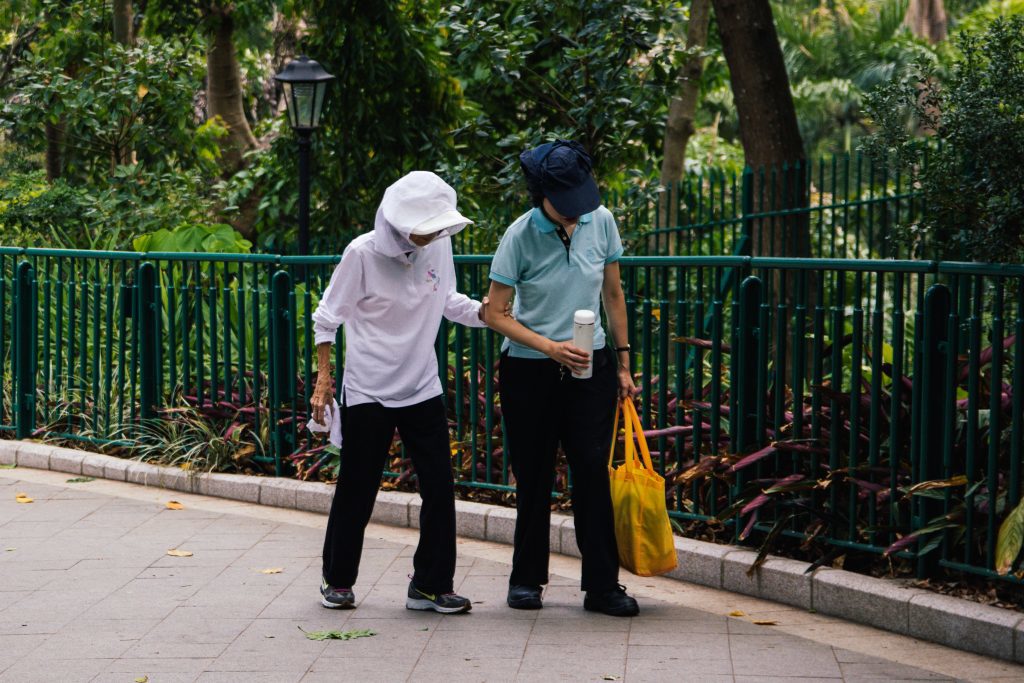
A woman guides an elder through Hong Kong's Botanical Gardens. (Celina Gallardo/RSJ)


What can we do about it? Nothing. If death comes, we get ourselves cremated, splash our ashes into the sea and I think that’s the cheapest way,” Francis Lam said. Lam, 70, is a retired construction worker who now volunteers with the Society for Community Organization (SoCO), a human rights advocacy group.


Although Lam has accepted that his remains will do anything but stay in an urn, he can’t help but wish for things to be different. “I still want to have my ashes put in some place where my descendants can come and worship and pay a visit to me once in a while and remember me by, you know? But if my ashes are gone, there’s nothing left,” Lam said.


Hong Kong’s census and statistics department estimates that Hongkongers aged 65 and over will take up 27 per cent of the overall population by 2033 (for comparison, Hong Kong’s elderly took up 11.7 per cent of the overall population in 2003). Data gathered by Hong Kong’s Commission on Poverty shows that in 2016, 337,400 elders — about 30 per cent of Hong Kong’s elderly population — were living below the poverty line, even after financial assistance from the government.


The feeling of not having any control over what is to come is common amongst elders. But in the hopes of making elders an active part of shaping Hong Kong’s future, one NGO has a solution: to design with empathy.

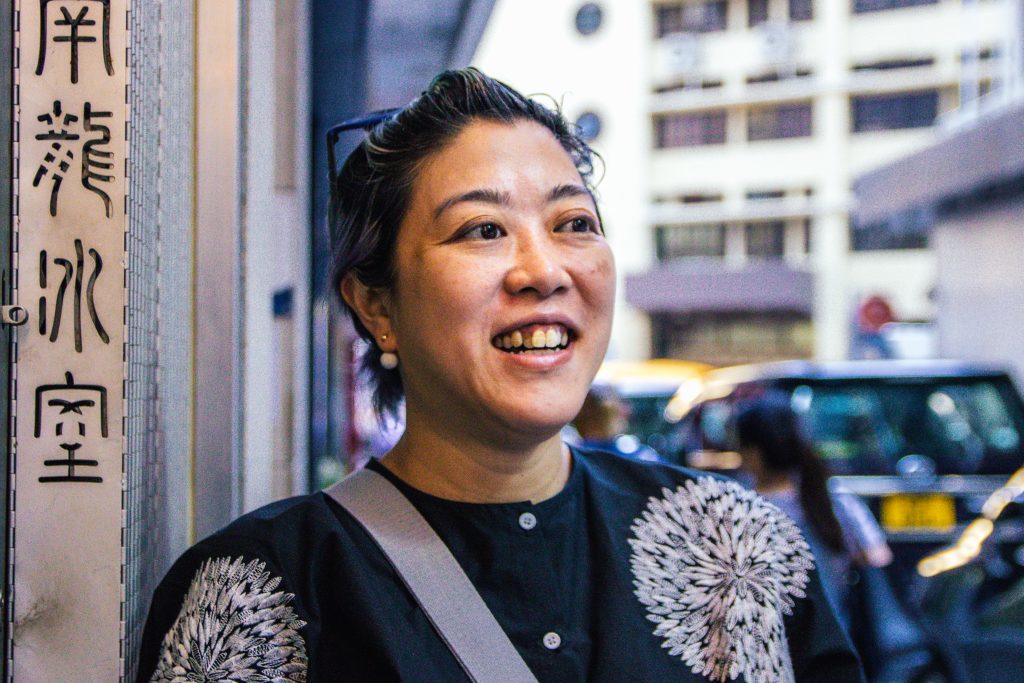
Yanki Lee, co-founder of the Enable Foundation. (Celina Gallardo/RSJ)

Yanki Lee, 45, co-founded the Enable Foundation last April after receiving funding from the Hong Kong government for social innovation. They’ve been given funding for two years to run the Social Innovation Design Lab, a cross-generational training program aimed at designing for the future. They plan on working with almost 1,000 youth and 400 elders. This year, their focus is on designing for a future that will work for the incoming flux of elderly people, to design for their future selves.

What sets them apart from other elder-focused projects is their methodology. “We don’t design for the elderly,” Lee said. “We design with the elders.”


It’s one of the benefits of taking a design approach to future solutions since “design thinking is about bringing empathy to people,” said Albert Tsang, Enable Foundation’s design researcher. “In order to design something for others, you have to have empathy.”


Traditional elder-centric design is usually based on medical concerns, such as making sure ramps and railings are available in most spaces. For Lee, this is what urban design should be concerned about in the present. But the Enable Foundation is looking to design concepts meant for Hong Kong’s future. “For us, it’s more important to involve the people who are elders now and then thinking about the future,” Lee said.


So far, the foundation’s projects reflect Lee’s work from the past decade; she has worked with elders all around the world. And, considering that she grew up with her stylish late grandparents, it’s no surprise that Lee has spent her career designing for elders. She even thinks some of the elder volunteers look like her grandfather. While working with elders, Lee never felt she needed to help them. Rather, she looked at them for inspiration.


She came up with these three projects based on what all the elders she’s spoken to seem to care about the most.


Their very first project, called Fine Dying, called upon elders and younger generations alike to think of new and better ways to bury their dead. The elders acted as mentors to the younger volunteers, some of whom have never been to a cemetery before. Around 400 design students from different universities and 100 elders went to cemeteries and hospitals to encourage younger members to experience these spaces firsthand and to see how they can be improved for the next wave of elders. Then they work with product designers to create objects to bring their concepts to life.


It started with a few of the elder volunteers who said that they’d want people to be able to dispense ashes in a garden burial, also called a garden of remembrance, using both of their hands, almost as if they are lovingly holding someone for the last time. These elders were able to see this concept come to life, first in the form of sketches, then in the form of prototypes, and finally: the envelope.

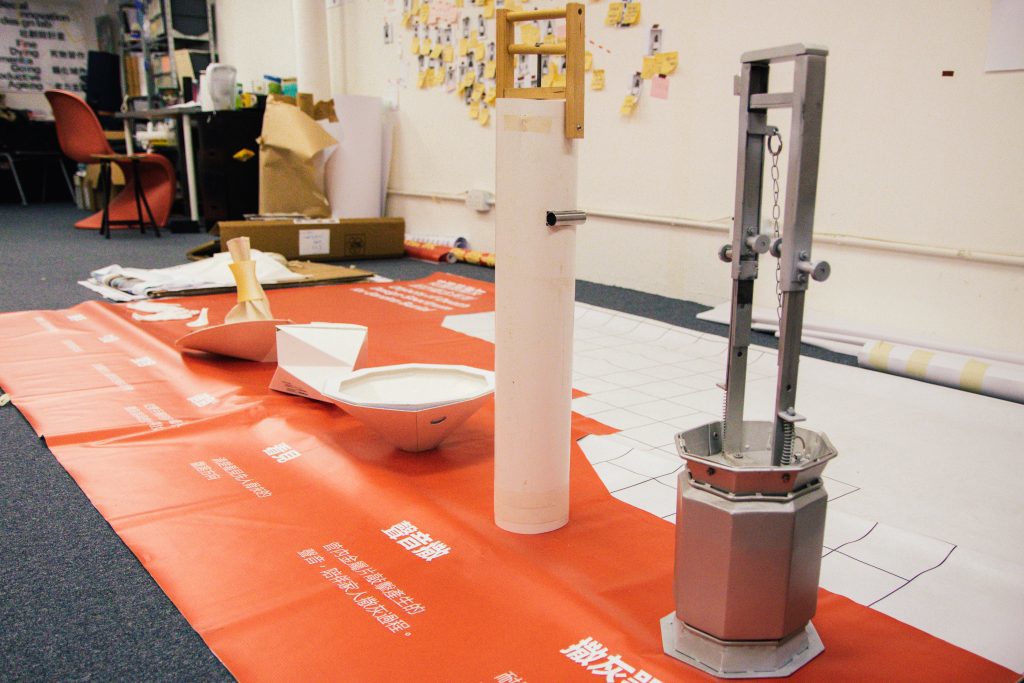
A traditional ash dispenser (far right) beside various dispenser prototypes (Celina Gallardo/RSJ).


Typically, people would spread ashes in gardens of remembrance using a metal dispenser that only requires one-handed action to disperse its contents. Although this method is economical (it can be reused multiple times), it often makes the process of spreading ashes feel cold and detached.


This is where the envelope comes in. It’s essentially a template made out of thick, white cardstock that, after a few simple folds, turns into a three-dimensional polygon that nestles comfortably into its user’s hands. A person would pour the ashes into the envelope before making the last fold. Then, that person would hold it with two hands while slowly shaking the ashes onto grass or pebbles through a hole in the front of the envelope. Once the envelope is empty, it can then be burned in an incinerator. None of the Enable Foundation’s projects are meant for commercial use, which is why the envelope is free of charge. Students from the Chinese University of Hong Kong will get a chance to use the envelope during a special burial ceremony for people who have donated their bodies for their studies, whom they call their silent teachers. It’s their way of showing gratitude to the donors and their families.  


With Fine Dying, people often ask whether Lee and her team are trying to design hospice facilities or care homes. Instead, Fine Dying is about preparing for the future elders with Hong Kong’s current elders. “The Fine Dying project is about a fine dying experience for all of us,” Lee said. They’re not elderly, they’re not the ones who need help — they are our elders. They know about our society well, they know much more about society and how it works because they’ve lived longer.”

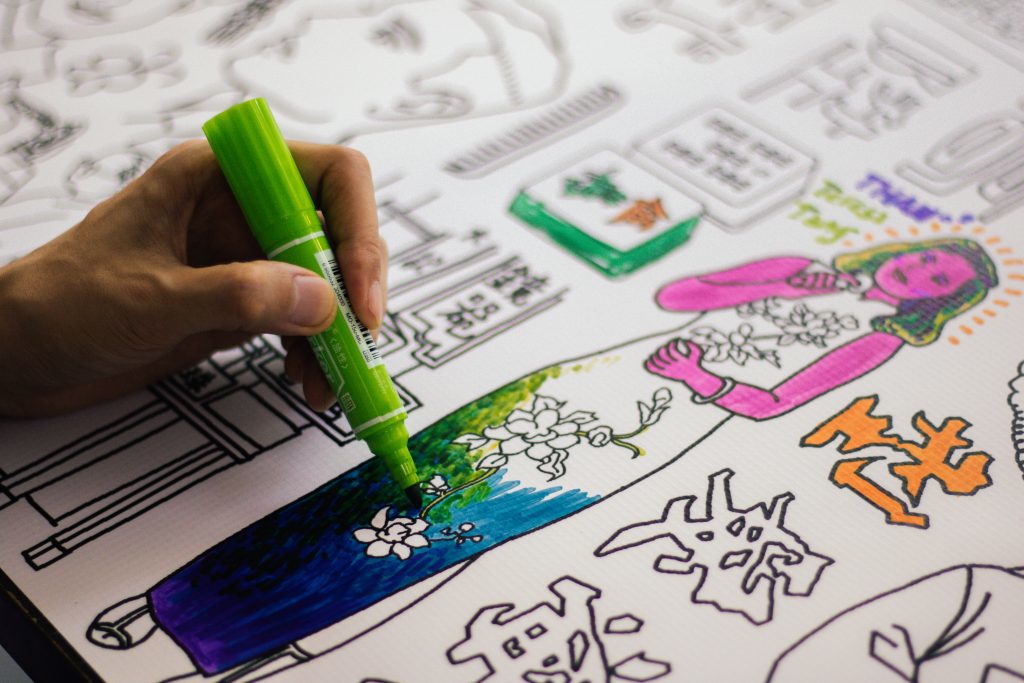
Albert Tsang, a design researcher for the Enable Foundation, colours in a drawing of late Chinese singer Teresa Teng. (Celina Gallardo/RSJ)


Another project by the Enable Foundation is called Dementia Going, a visual exploration into how it feels like to have dementia. One of the installations involved two colouring books printed on 17-metre rolls of canvas. But they’re more than just colouring books — they’re an amalgamation of stories and memories from Hong Kong elders with dementia.


Every single drawing printed on each canvas came to life through a meticulous information gathering process. A few months ago, volunteers visited several elders with dementia and spent time with them to find out their fondest memories from their earlier years. Simply writing down what the elders said, however, would have been difficult, since their thought processes are usually scattered. As a solution, Lee had the volunteers create collages that encapsulated each elder’s story. They glued images of food, farmland and famous people from magazines onto sheets of paper, which were then given to a graphic illustrator to recreate into a colouring book.


To Lee, creating a colouring book was the best way to get people to connect with each elder’s stories. Lee also spent time with elders with dementia while studying in London almost ten years ago. Whenever patients felt stressed, Lee would get them to unwind by giving them colouring books.


One of Lee’s most rewarding moments was during the foundation’s workshop for creating a dementia-inspired city. One particular elder was impressed with a draft for Dementialand, an Alice-in-Wonderland-like environment that simulated how dementia would feel like. The elder told Lee that he had never fully understood dementia until seeing Dementialand, despite having friends and family with the condition. “It’s so encouraging that our approach is giving a new spotlight on the issues,” Lee said. “We really respect the elders as our partners, advisers.”


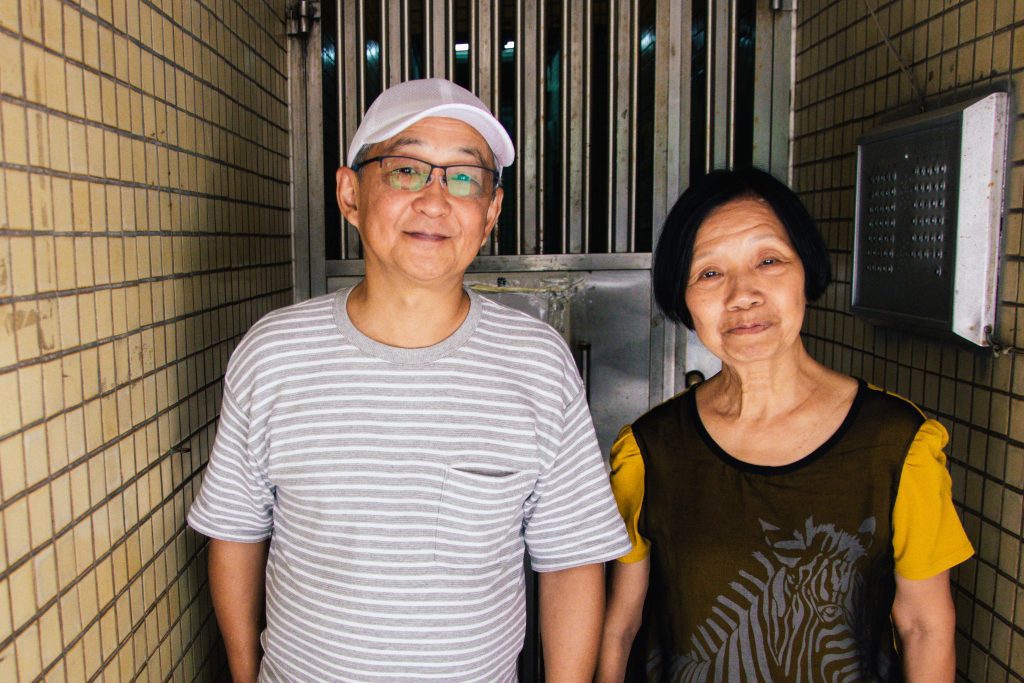
Francis Lam and Ho Chu Fung stand in front of the Society for Community Organization's office building. (Celina Gallardo/RSJ)


Ho Chu Fung, who goes by Ms. Fung, volunteers for SoCO with Lam. She doesn’t speak English, but her kind, sunken eyes spoke for themselves. Lam, sitting beside her in one of the organization’s storage rooms, acted as Ms. Fung’s translator, summarizing the generational gap that divides her from her son and grandchildren. Ms. Fung says that it could be because of the westernization of Hong Kong and how the traditional Chinese respect-your-elders attitude is fading away.


What also adds to the isolation, Lam explains, is Hong Kong’s Comprehensive Social Security Aid, which only provides financial assistance to elders who don’t live with their family.


“If you live with your children, they should take care of you, not the government. So this is a very cruel system and this is why old folks feel very lonely,” Lam said.


NGOs like SoCO and the Enable Foundation continue to work towards a future that sees elders thrive. But at the end of the day, Ms. Fung and Lam simply want younger generations to spend more time with elders like themselves.“The only thing [Ms. Fung] wants to tell younger people is to pay more attention to the elderly,” Lam said. “Give us more time and love. That’s all… This is our message.”

Behind the Byline

At first, I was reluctant to make this a story about Hong Kong’s diminishing cemetery space, since I thought it was already reported on enough. Speaking with Yanki Lee and the rest of the Enable team, however, made me look at the issue in a new angle. The fact that so much consideration went into designing the envelope made me love it even more. I’m also very fascinated with death and how certain cultures deal with it. What was also great about this angle was that I was able to stay true to my initial pitch: to tell a story about Hong Kong’s rapidly aging population.


Like Lee, I grew up with my grandparents and they’ve been integral in shaping who I am today and seeing them always makes me think of my future elderly years. Having that relationship with my grandparents made speaking to elders in Hong Kong feel more intuitive and almost nostalgic. It also made seeing elderly people sitting alone or pushing heavy carts through thick, humid air even more heartbreaking. But I was glad to find out that they’re not becoming completely forgotten. I definitely won’t.


Aside from reporting on this story, so many things happened in Hong Kong that will remain unforgettable: eating at a dai pai dong, finally riding a cable car, and going into abandoned mansions (which was certainly worth missing Cirque du Soleil for).

Previous Next
Close
Test Caption
Test Description goes like this